
Exam at a glance
| Duration | 120 minutes |
|---|---|
| Maximum marks | 100 |
| Pass mark | 60% |
| Negative marking | 25% |
| Fee | ₹1,500 |
| Validity | 3 years |
Verified against the official NISM list; confirm before registering. Full comparison on our exams table.
Coming from equity derivatives? Read this first
The instruments look familiar, so candidates transfer their equity instincts across — and lose marks on exactly the parts that do not transfer.
| Equity derivatives (VIII) | Commodity derivatives (XVI) | |
|---|---|---|
| Underlying | Financial — shares, indices | Physical — metals, energy, agricultural goods |
| Settlement | Cash | Cash or physical delivery |
| Quality | Not applicable | Grade and quality specifications matter |
| Storage | Not applicable | Warehousing, warehouse receipts |
Futures, options, margining and hedging logic carry across almost intact. Delivery, warehousing, quality specifications and the settlement calendar have no equity equivalent, which is why they are both the hardest section for switchers and the most predictable marks once studied.
What the paper covers
From the official workbook — free from nism.ac.in, and the authoritative syllabus:
- Commodity markets — participants, price formation, the role of the exchanges
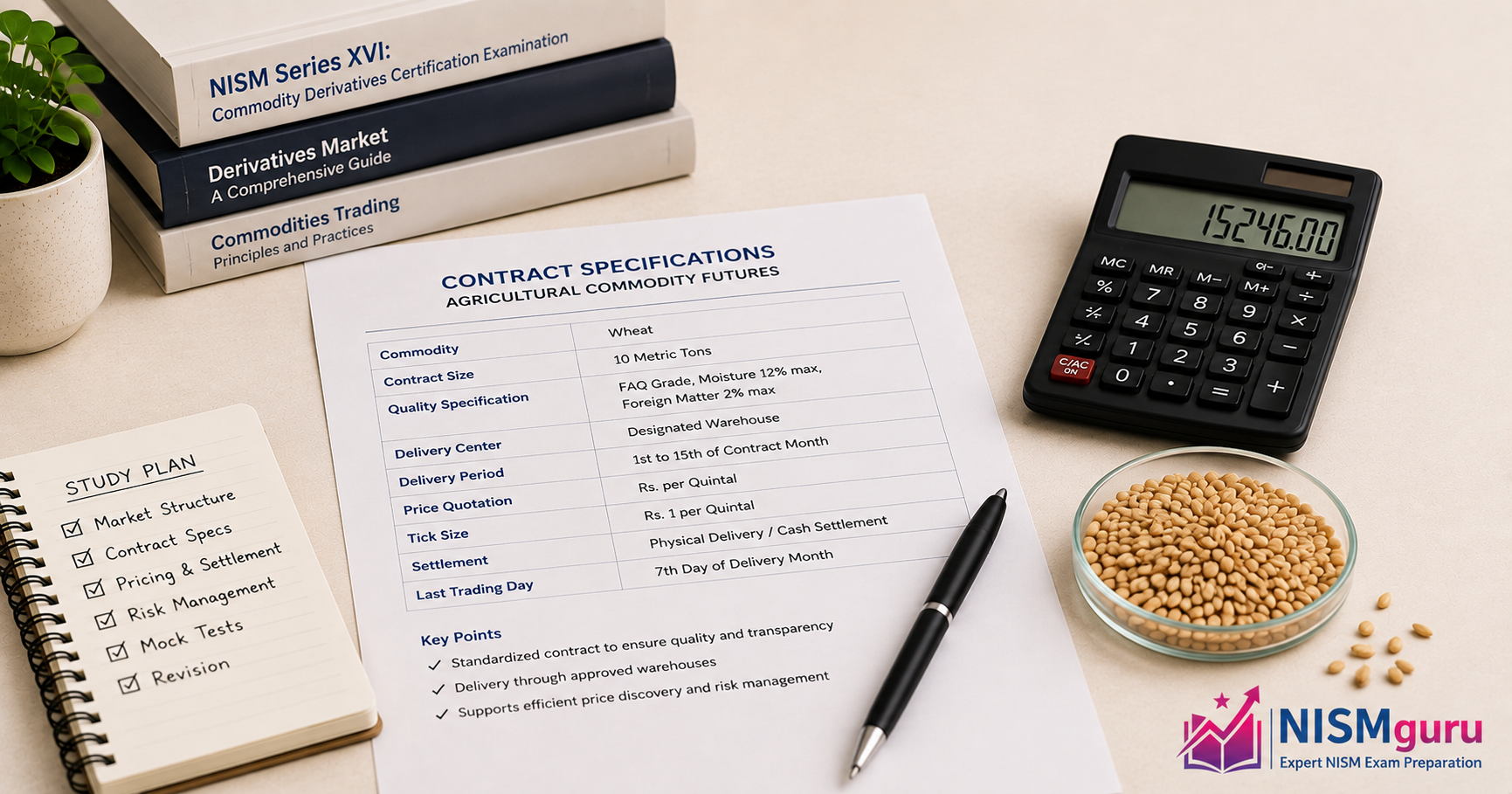
- Contract specifications — what a listed contract actually says
- Hedging and trading strategies specific to commodities
- Delivery, warehousing and settlement mechanics
- Margining and risk management
- The regulatory framework governing the segment
Where candidates lose marks
Contract specifications studied in the abstract. The exam asks about particular contract features — lot size, tick size, delivery centre, quality grade. Reading "contracts have specifications" is not preparation for that.
Delivery and warehousing skipped. Dry, mechanical and entirely predictable. Skipping it is the single most avoidable mistake on this paper, and switchers from Series VIII do it most because nothing in their existing knowledge flags it as important.
Margin arithmetic under time pressure. As with any derivatives paper, the distractors are built from the common calculation slips.
A three-to-four week plan
- Week 1 — commodity market structure and participants. If you know equity derivatives, move fast here.
- Week 2 — contract specifications and, critically, delivery, warehousing and quality. Give this the most time regardless of your background.
- Week 3 — strategies, margining and regulation. Work the numericals by hand.
- Week 4 — timed full-length papers, with every explanation read.
Take your first full mock at the end of week two. Our Series XVI mock test reproduces the real interface, timing and negative marking, and it will show you immediately whether the delivery chapters are the gap.
Negative marking
25% for a wrong answer, same as Series VIII. Attempt when you can eliminate one or two options; leave when you cannot. Details across all papers in our post on passing marks and negative marking.
Who needs it
The certification applies to approved users and sales personnel of members in the commodity derivatives segment. The requirement is role-dependent and set by SEBI or the exchange, so confirm your specific obligation rather than inferring it from a comparison page.
The delivery chapters are where switchers lose marks. Our Series XVI mock tests use the real interface and timing, with an explanation for every question, so you can see exactly which sections cost you. Free demo before you pay. Try the Series XVI mock test.