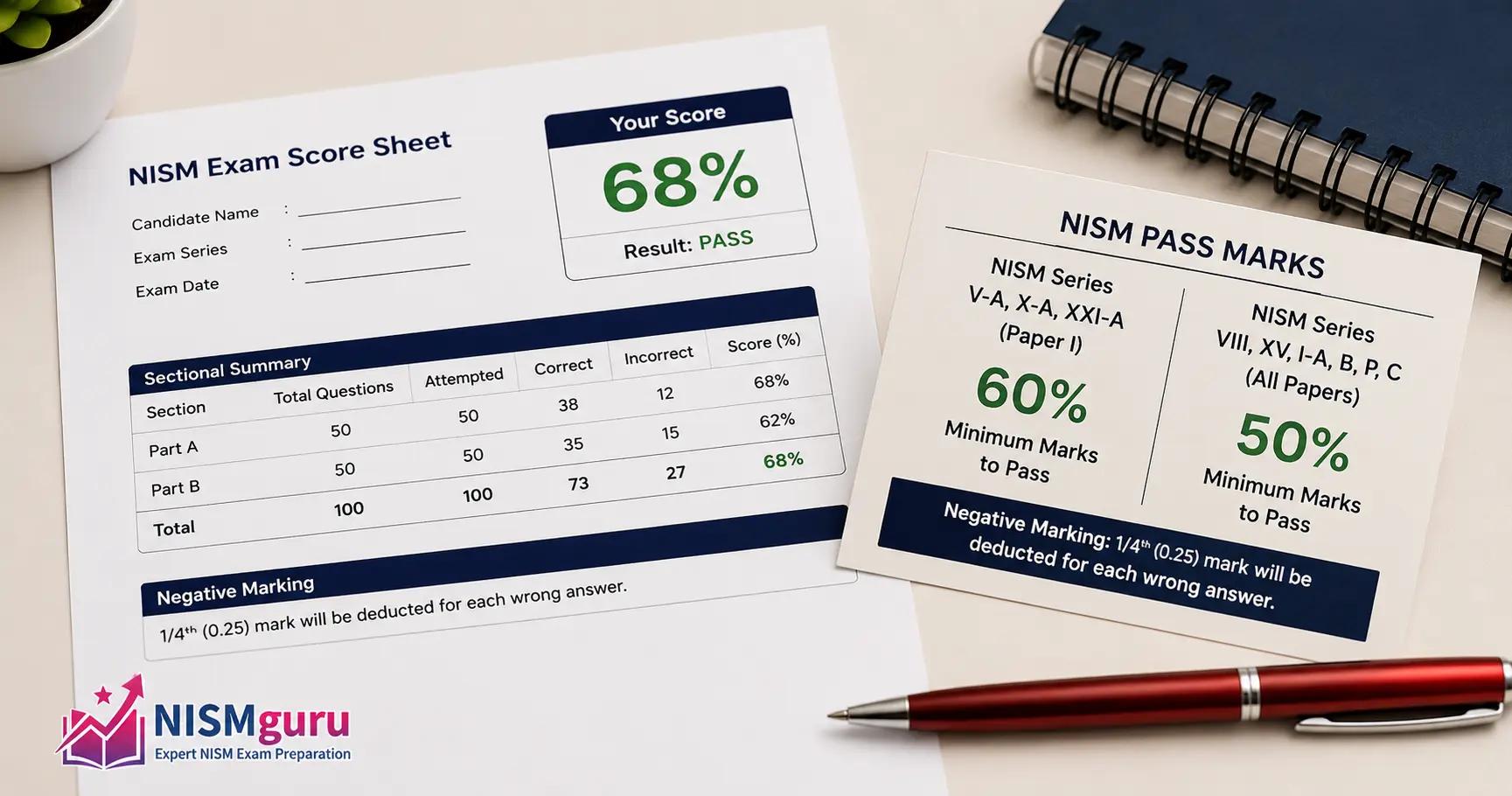
Ask what you need to pass a NISM exam and you will usually be told 60%. That is right for most papers and wrong for eleven of them — and if yours is one of the eleven, you have been preparing against a target four or five marks higher than the one that actually applies.
Two numbers decide whether you pass: the pass mark, and the negative marking. They vary independently, and the combination matters more than either on its own.
The default: 60% with 25% negative marking
Most SEBI-mandated certifications work like this. Series VIII (Equity Derivatives), XV (Research Analyst), XVI (Commodity Derivatives), VI (Depository Operations) and the majority of the rest all require 60% and deduct 25% of a question's marks for a wrong answer.
On a 100-mark paper that means 60 marks to pass, and every wrong answer costs you a quarter of a mark on top of the mark you did not earn.
The exams that need only 50%
Eleven of the 34 certifications pass at 50%. Several are the ones candidates sit most.
| Series | Certification |
|---|---|
| II-A | Registrars to an Issue & Share Transfer Agents – Corporate |
| II-B | Registrars to an Issue & Share Transfer Agents – Mutual Fund |
| V-A | Mutual Fund Distributors |
| V-B | Mutual Fund Foundation |
| VII | Securities Operations and Risk Management |
| X-C | Investment Adviser (Renewal) |
| XV-B | Research Analyst (Renewal) |
| XXV-A | Persons Associated with Research Services |
| XXV-B | Persons Associated with Investment Advice |
| XXIV | AML & CFT Provisions in Securities Markets |
| IFSCA-01 | AML & Counter Terrorist Financing in IFSC |
Series V-A is the significant one. It is the most-sat NISM exam in India — the ARN route for mutual fund distributors — and it passes at 50% with no negative marking at all. If that is your exam, every question is worth attempting, because a wrong answer costs exactly the same as a blank one.
How much a wrong answer costs
Negative marking is not uniform either.
| Penalty | Applies to | What it means |
|---|---|---|
| 25% | Most SEBI-mandated exams, including VIII, XV, XVI, X-A, X-B | A wrong answer costs a quarter of the question's marks |
| 10% | V-D, XXI-A, and the AIF distributor papers XIX-A and XIX-B | A lighter penalty — guessing is less punishing |
| None | V-A, V-B, II-A, II-B, X-C, XV-B, XXV-A, XXV-B, XII, XXIV, IFSCA-01 | A blank and a wrong answer score identically |
The practical rule follows directly. Where there is no negative marking, never leave a question blank — a guess is free. Where the penalty is 25%, a blind guess across four options has negative expected value, so leaving it is the better play unless you can rule out at least one option.
The exam that is harder than its pass mark suggests
Series VII — Securities Operations and Risk Management — is the one to watch. It is the only certification that pairs a 50% pass mark with 25% negative marking.
That combination reads as generous and is not. The lower pass mark tempts candidates into attempting everything, while the penalty quietly claws marks back from every guess. Candidates who treat Series VII like Series V-A — where guessing is genuinely free — routinely score below their own practice results.
A 50% pass mark with 25% negative marking is not an easy exam. It is an exam that punishes the strategy its pass mark invites.
Where the marks actually go
Pass marks are a floor, not a target. Two habits move a real score more than knowing the threshold:
- Work the calculations rather than eliminating options. On the derivatives papers especially, distractors are built from the common arithmetic mistakes. An option that "looks right" is often the answer you would get by dividing where you should multiply.
- Practice under the clock. Almost nobody fails a NISM paper on knowledge alone. They fail by spending eleven minutes on a question worth one mark and rushing the last fifteen.
You can check the exact pass mark, duration, maximum marks and negative marking for any certification on our complete NISM exams table, which is verified against the official NISM list. If your paper is one we cover, a timed mock test will tell you where your marks are actually going — which is rarely where candidates assume.
One caution
NISM sets these figures and revises them. Everything here was checked against the official certifications page in July 2026, but confirm your specific exam before you sit it. A page like this is a planning aid; the awarding body is the authority.
Find out where your marks go before the exam does. Our mock tests use the real interface and timing, with an explanation for every question and chapter-wise analytics showing exactly which topics are costing you. Free demo before you pay. Try a free mock test.