Every NISM certification is a computer-based, multiple-choice exam sat at a test centre. Beyond that, the pattern is not uniform — and the differences decide how you should pace yourself.
The two exam formats
Almost every NISM certification uses one of two shapes.
| Format | Duration | Maximum marks | Pass mark | Typical papers |
|---|---|---|---|---|
| Standard | 120 minutes | 100 | 50% or 60% | V-A, VIII, XV, XVI, VI, VII and most others |
| Extended | 180 minutes | 150 | 60% | V-D, X-A, X-B, XIII, XIX-C, XXI-B |
A third, shorter shape covers the renewal and associate papers — 60 minutes against 50 marks — used by X-C, XV-B, XXV-A, XXV-B and the AML certifications.
The extended format is not simply a harder version of the standard one. It is a longer paper with more marks available, and the fee reflects that: ₹3,000 against ₹1,500, as covered in our guide to NISM exam fees.
Why nobody can tell you the number of questions
Search for "how many questions in NISM Series VIII" and you will find confident, contradictory answers. Here is why.
NISM publishes maximum marks, not question counts. Papers mix one-mark and two-mark questions, so 100 marks is not 100 questions — and the mix is not fixed.
A 100-mark paper might be 100 single-mark questions, or 85 one-mark plus a handful of two-mark items. Both satisfy "100 marks". Anyone stating a precise question count for a specific NISM paper is guessing, and we do not publish one for that reason. Our exams table lists maximum marks because that is the figure NISM actually publishes.
What this means practically: budget your time against marks, not questions. On a 120-minute, 100-mark paper you have a little over a minute per mark. That is the number to pace against.
Question types you will meet
Within the multiple-choice format, questions fall into recognisable groups. Knowing which kind you are looking at changes how you should attempt it.
- Direct recall — a definition, a threshold, a timeline. Fast marks; answer and move.
- Applied concept — a short scenario testing whether you can apply a rule rather than recite it. The bulk of most papers.
- Numerical — NAV, returns, margins, option payoffs. These are worked, not recognised, and the wrong options are usually built from the common arithmetic errors, so an answer that "looks right" may be the one you get by dividing where you should multiply.
- Regulatory — precise SEBI provisions, limits and obligations. The most predictable marks on any paper and the most commonly underprepared.
The derivatives and adviser papers lean numerical; the compliance and distributor papers lean regulatory. Your revision should lean the same way your paper does.
Negative marking changes the pattern
Format alone does not tell you how to attempt the exam — the penalty does.
Most SEBI-mandated papers deduct 25% of a question's marks for a wrong answer. A few deduct 10%. Several — including Series V-A, the most-sat exam in the country — deduct nothing.
That difference is strategic, not trivial. With no penalty, leaving a question blank is strictly worse than guessing. With a 25% penalty, a blind guess across four options loses marks on average, so an unnarrowed question is better left alone. The full breakdown by exam is in our post on passing marks and negative marking.
The interface is part of the exam
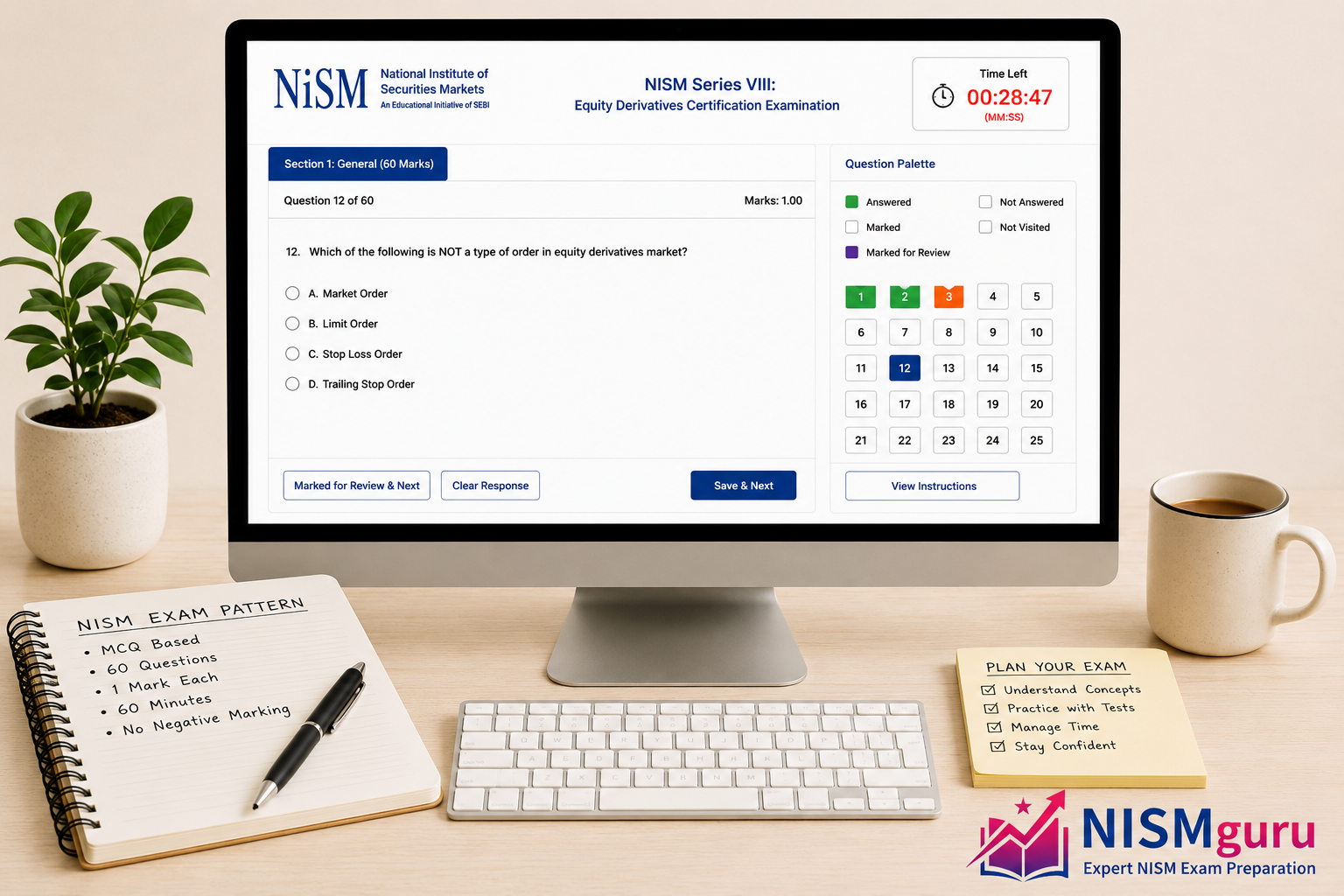
Because these are computer-based, the screen itself matters: a question palette showing answered, unanswered and marked-for-review items, a countdown clock, and navigation between questions.
Candidates meeting that interface for the first time on exam day lose minutes to it — not many, but on a paper where you have a minute per mark, minutes are the margin. Practising on a mock test that uses the same interface removes the whole category of problem.
Pacing, concretely
For a 120-minute, 100-mark paper:
- First pass — answer what you know. Do not stall on anything. Mark it and move.
- Second pass — the marked questions. By now you know how much time you have per remaining item.
- Final ten minutes — review, and decide the guesses. If your paper has no negative marking, fill in everything. If it deducts 25%, leave what you genuinely cannot narrow.
Most candidates who fail a NISM paper do not fail on knowledge. They fail by giving eleven minutes to a one-mark question and rushing the last fifteen.
One caution
NISM sets exam patterns and revises them. Durations, marks and negative marking were verified against the official certifications page in July 2026 — confirm your specific paper before you sit it.
Meet the interface before exam day. Our mock tests reproduce the real exam screen, timing and question style, with an explanation for every answer and analytics showing which chapters cost you marks. Free demo before you pay. Take a free mock test.