Negative marking is the most misunderstood rule in NISM exams. Candidates either ignore it and attempt everything, or fear it and leave marks on the table. Both cost you, and which mistake you are making depends on a rule you can check in thirty seconds.
First, know your paper
Three regimes exist across the 34 certifications:
- 25% deduction — most SEBI-mandated papers, including Series VIII, XV, XVI, VI, X-A and X-B
- 10% deduction — Series V-D, XXI-A, and the AIF distributor papers XIX-A and XIX-B
- No deduction — Series V-A, V-B, II-A, II-B, the renewal papers X-C and XV-B, XXV-A, XXV-B, XII and the AML papers
The full list by certification is in our reference post on passing marks and negative marking, and every figure is on our exams table.
Check yours before you build any strategy on top of it. Series V-A — the most-sat NISM paper in the country — has no negative marking at all, and a great many candidates sit it playing defensively for no reason.
The arithmetic of a guess
Assume a one-mark question with four options.
| Situation | Expected value of guessing | Verdict |
|---|---|---|
| No negative marking | +0.25 marks | Always guess. A blank is a wasted mark |
| 25% penalty, no eliminations | 0.25 × 1 − 0.75 × 0.25 = +0.0625 | Marginal. Roughly break-even |
| 25% penalty, one option eliminated | 0.33 × 1 − 0.67 × 0.25 = +0.17 | Guess |
| 25% penalty, two eliminated | 0.5 × 1 − 0.5 × 0.25 = +0.375 | Definitely guess |
On a paper with no negative marking, leaving a question blank is simply throwing away a mark. There is no defensive reason for it, and no strategy involved.
The 25% blind guess sits close to break-even in pure expected value. In practice, treat it as not worth it — because exam-hall guesses are rarely truly random. You are usually drawn to a plausible-looking distractor built from a common mistake, which makes your real odds worse than the maths above assumes.
So the rule is
If your paper has no negative marking: finish with nothing blank. Make it a hard rule and check the palette in the last two minutes.
If it deducts 25%: attempt when you can eliminate at least one option. Leave when you genuinely cannot narrow it. "I have a feeling about B" is not an elimination.
If it deducts 10%: guessing is cheaper. One elimination makes it clearly worthwhile.
Elimination is a skill, not a hope
The whole strategy rests on being able to rule options out. Three things that reliably work:
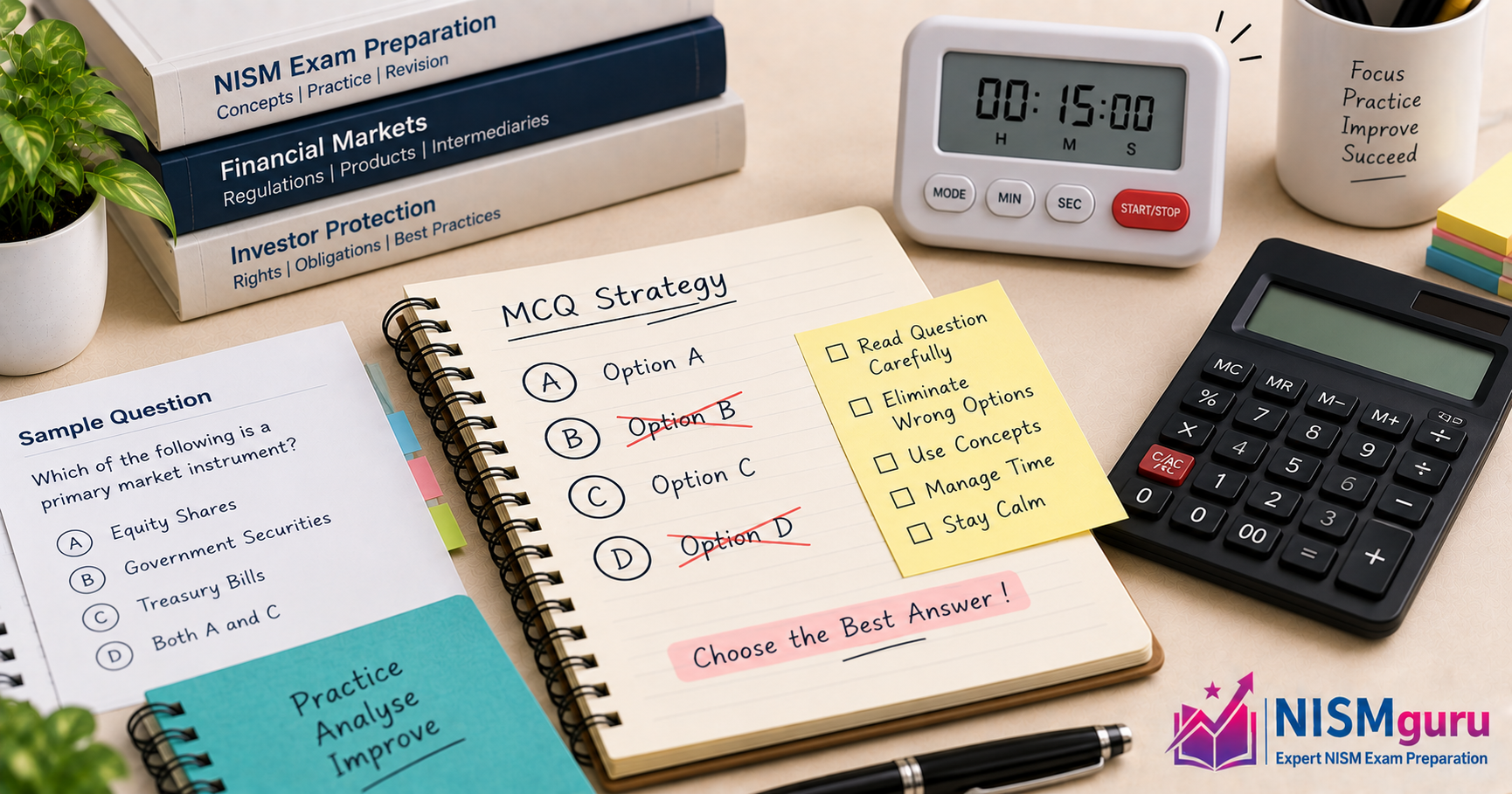
Watch for absolutes. Options containing "always", "never" or "all" are more often wrong than right in regulatory questions, because regulation is full of exceptions.
Check the units and magnitude on numerical questions. A distractor is frequently the right method with the wrong scaling — an answer a hundred times too large is a calculation error you can spot without redoing the work.
Two options saying the same thing differently are usually both wrong. If neither can be uniquely right, the answer is generally elsewhere.
Where negative marking actually costs people
Not in the guesses. In the panic pass — the last five minutes when a candidate fills in every remaining blank on a 25% paper because leaving them feels like giving up.
On ten remaining questions with no eliminations, that habit is roughly break-even at best and negative in practice. Meanwhile the candidate has spent their final minutes filling boxes rather than reviewing the questions they could have got right.
The disciplined version: in the last five minutes, review two or three questions you marked as uncertain but understand, rather than blind-guessing ten you do not.
Practise the decision, not just the syllabus
This is a skill that only forms under time pressure. Knowing the rule in a calm moment is not the same as applying it with four minutes left and eight blanks showing.
Our mock tests reproduce the real interface, timing and the negative marking of the actual paper — so the decision gets rehearsed rather than improvised. The analytics afterwards will also tell you something useful: whether your wrong answers cluster in a topic (a knowledge gap) or scatter evenly (a pacing or guessing problem). Those need different fixes.
One caution
Negative marking is set by NISM per certification and can be revised. The figures here were verified against the official list in July 2026 — confirm your specific paper before you sit it.
Rehearse the decision under a clock. Our mock tests use the real interface, timing and negative marking, with explained answers and analytics showing whether your losses are knowledge or pacing. Free demo before you pay. Take a free mock test.