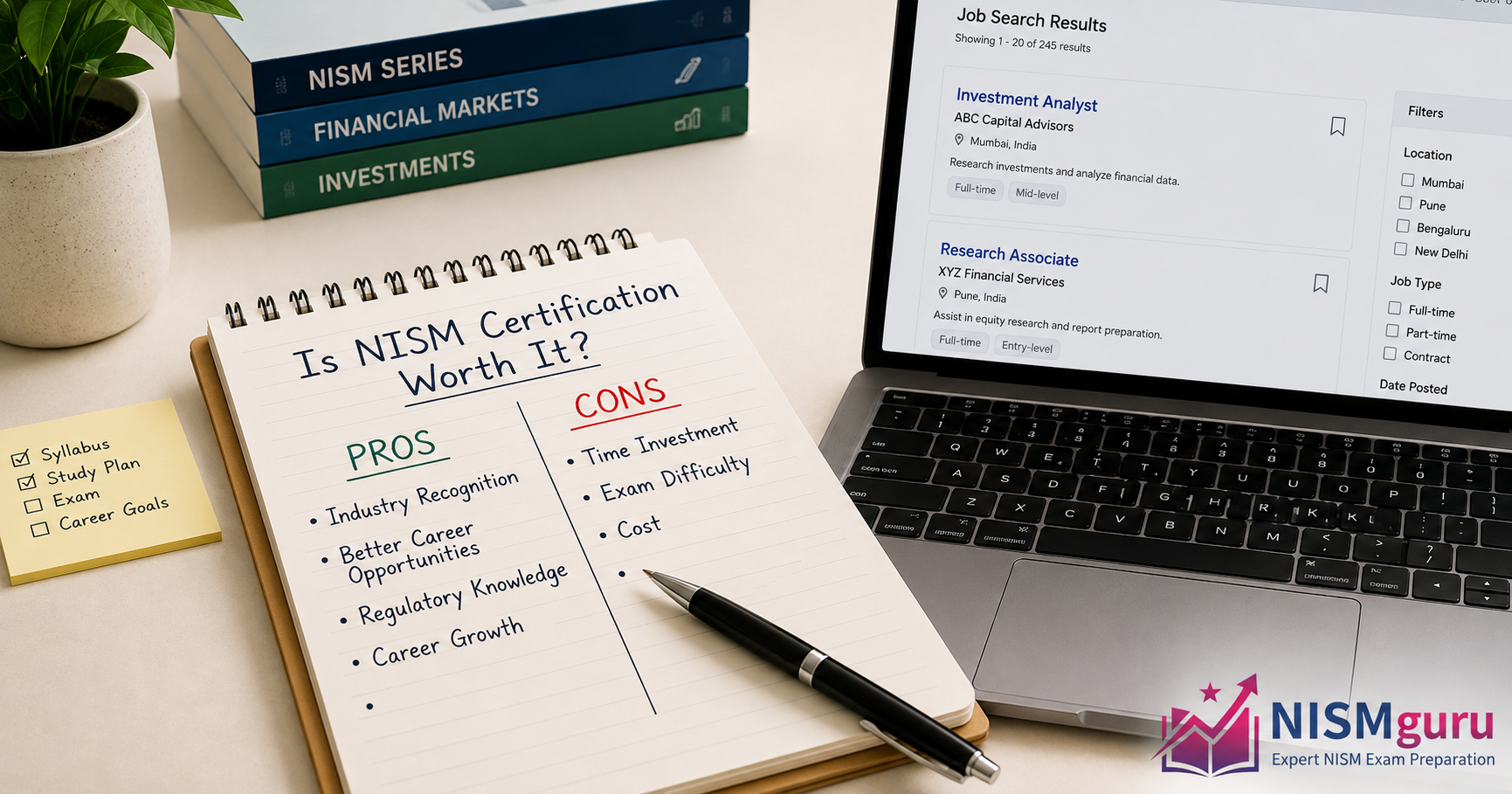
Most pages answering this question are selling something, so they answer "yes". The honest answer is narrower and more useful: it depends almost entirely on whether the certification is mandatory for the role you want. Get that straight and the rest of the decision makes itself.
Mandatory or optional — which are you looking at?
NISM certifications fall into distinct groups, and they are not equally worth your money.
| Type | What it means | Worth it? |
|---|---|---|
| SEBI-mandated | Legally required to hold the role at all | Not a choice — it is the price of entry |
| PFRDA / IFSCA-mandated | Required for specific pension or IFSC roles | Same, within those roles |
| Non-mandatory | Voluntary, e.g. Securities Markets Foundation (XII) | Only if it earns you something specific |
If your certification is in the first group, the question does not really apply. You cannot distribute mutual funds without Series V-A, and no amount of deliberation changes that. The only real decision is when to sit it and how to pass first time.
If the certification is mandatory for your role, "is it worth it" is the wrong question. The right one is "how do I pass it once rather than twice".
Our full exams table marks which of the 34 certifications are mandated and by whom — that is the fastest way to find out which group yours is in.
What it actually costs
The honest arithmetic, so the decision is made on real numbers.
- The exam fee: ₹885 to ₹3,000 depending on the certification; most commonly sat papers are ₹1,500. Full breakdown in our fees guide.
- Study material: ₹0. The official workbook is a free download.
- Your time: three to four weeks alongside a job, for a standard paper.
- Renewal: most certifications are valid three years, after which you renew via CPE or by re-passing. See validity and renewal.
- A second attempt, if it happens: the full fee again. NISM offers no re-sit discount.
That last one is the whole argument for preparing properly. The difference between a first-attempt pass and a second attempt is larger than any other number here.
What the certification does for you
Being specific, rather than making claims we cannot support:
It makes you eligible. For mandated roles, this is the entire value and it is absolute — without it you cannot legally hold the role. That is not a small thing.
It is a recognised, verifiable credential. NISM is a SEBI-established institution, so the certification means the same thing to every employer in the Indian securities market. It does not need explaining on a CV.
It gives you structured coverage of your domain. The workbooks are genuinely comprehensive, and for people who came into finance sideways they fill gaps that experience alone leaves.
What it does not do
Just as important, and rarely said:
It is not a job offer. A certification makes you eligible; it does not make you employed. For a mandated role it is table stakes — everyone else applying has it too.
It is not a substitute for experience. Nobody is hired to manage a portfolio because they passed Series XXI-B.
It does not guarantee a salary increase. Compensation depends on role, employer, location and experience. Any page quoting you a specific figure a NISM certification "will" earn is guessing — including, honestly, most of the pages ranking for it.
It expires. Most certifications run three years and then need renewal, at a cost. This is an ongoing commitment, not a one-off purchase.
When a non-mandatory certification is worth it
The voluntary papers are a real decision, and there are two cases where they pay.
You are entering the industry and want to test the ground. Securities Markets Foundation (Series XII) costs ₹1,003 and is not required for anything — which is precisely its use. It is the cheapest way to find out whether the subject holds your interest before you commit to a mandated paper and a role that depends on it.
You want the adjacent credential. An adviser who also holds a research certification, or a distributor who adds insurance, widens what they can legitimately offer. That has value when it maps to work you will actually do — and none when it is collected for its own sake.
So, decide
Three questions, in order:
- Is it mandatory for the role I want? If yes, sit it and focus on passing first time. The question is answered.
- If not, what specifically does it let me do that I cannot do now? If you cannot name the thing, that is your answer.
- Can I give it three to four honest weeks? A cheap exam failed twice is not cheap.
For most people reading this the answer to the first question is yes — which turns the whole thing from a decision into a preparation problem.
If the exam is mandatory, the only thing left is passing it once. Our mock tests use the real exam interface and timing, with explained answers and a score for every attempt. Free demo before you pay. Take a free mock test.